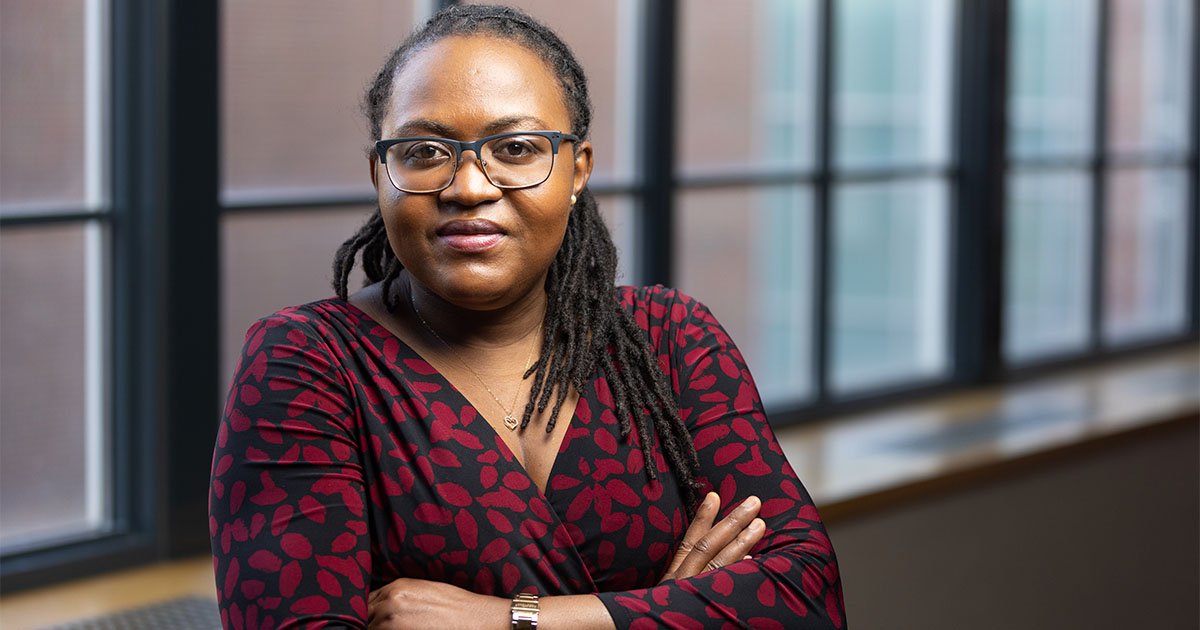

Tell us a little bit about yourself.
“I was born in Cameroon and grew up primarily with my grandparents. I immigrated to Massachusetts when I was in high school and stayed there for both my BSN and MPH before moving to Maryland to complete my PhD at Johns Hopkins. I got a postdoctoral fellowship at the University of Minnesota School of Public Health, and I have been here ever since. I liked the East Coast, but you can’t beat the lakes here in Minnesota.”
What made you decide to study public health?
“Growing up in Africa, my family and I faced several health challenges, like malaria and gastrointestinal diseases. I remember admiring the health practitioners I met, thinking that one day, I would be like them. But things changed after I came to the U.S. As an immigrant, we often think about the economy of our decisions—fully utilizing our time and resources strategically. So I became a nurse so I could enter the healthcare system before starting medical school. But after working in a hospital setting, I realized that I wanted to take care of more than just one person at a time. As a public health practitioner, I get to take care of thousands of people at a time, which is very appealing to me.”

What research are you currently focused on?
“My research is focused on supporting older immigrants, specifically those living with dementia and their families. I educate people about the disease–how to manage it, how to access healthcare and resources, and how to support both the individual living with dementia and their family members. My role takes a lot of outreach and community engagement because caring for someone with dementia takes a whole village. Immigrants are very hardworking, and often believe they can persevere through anything. But dementia is not a condition that you work through alone; it’s one where you are going to need a lot of help and support.”
What courses do you teach? What do you enjoy about working with students?

“I teach two courses, the first being Foundations of Public Health. That course is really cool because it’s an intro class, meaning I get to interact with a lot of students from different disciplines. I get to know them and start seeing them identify their own interests within public health. For example, I taught a veterinary student who realized how important their role as a public health veterinarian is through the “One Health” lens because the health of animals, humans, and the environment are connected. Seeing them make those connections is such a joy. The second course I teach is Community-Based Participatory Research, which helps students learn how to engage and conduct research with the community. I love seeing students recognize the value of building relationships with communities and partnering with them to implement research and community projects, programs, and outreach.”
 What is something about you that most people don’t know?
“Being on water is my happy place. Lying by the ocean or a lake makes me happy. My dream is to own a house near a lake or river so I can sit outside and sip coffee while looking at the water.”
What do you do when you are not working?
“I love being in community, so I go to a lot of events. In my free time, I am probably at a festival or a cultural group meeting, enjoying great food, music, art, etc.”
What are you reading or watching right now?
“I just started a book that I am very excited about! It’s called Falling Upward: A Spirituality for the Two Halves of Life by Richard Rohr. My favorite book is an old African classic called Things Fall Apart by one of the greats, Chinua Achebe.”